

A private conservancy camp is not automatically the better choice. It may suit travelers who want more flexible activities, while a camp inside the Maasai Mara can suit those who want to stay within the reserve. Private conservancies offer game drives with fewer vehicles, walking safaris, night drives and bush dining. The right fit depends on how you want to spend your time in the bush, not simply which setting sounds more exclusive.
Wildlife may be the first thing you consider, but where you stay shapes each day too. This guide compares handpicked safari camps in Kenya by booking terms, group size, guiding, wildlife experiences and tented facilities, helping you weigh the details that matter to your trip. You’ll see how camp size and location affect the feel of a stay, and which seasons suit different safari priorities. The goal is to make your choice clearer, whether you’re drawn to the Mara’s reserve setting or the added activities available in a private conservancy.
Key Takeaways
- Choose between a Mara stay and a private conservancy by matching the setting and available activities to the safari pace you want.
- Compare camp size and configuration to understand how each stay may shape the atmosphere and your day-to-day experience.
- Look beyond wildlife location when assessing guiding: the way you explore can be as important as what you hope to see.
- Review tent layout and en-suite facilities alongside your comfort needs to make a more informed camp choice.
- Use season, group preferences and preferred activities together to narrow down the stay that best fits your Kenya safari.
1. What is the best safari camp in Kenya?
Kenya’s best safari camp depends on your preferred landscape, season and style of stay. Loisaba Tented Camp overlooks 56 000 acres of private conservancies in Laikipia. Enaidura Camp is one option to consider when comparing safari camps in the Maasai Mara. These camps offer distinct settings, so compare location and scale before choosing. For a luxury safari, consider how you want to spend time game viewing and whether a tented camp suits your comfort preferences. Handpicked safari camps are most useful as a shortlist, not a universal ranking.
Travel dates can help narrow your options. July to October is recommended for seeing the Great Migration on a Kenya safari. January to March brings calving season, fewer crowds and competitive rates. June offers excellent dry-season game viewing as the season begins. Match your dates to the experience you value, then choose a camp in a suitable area. Seasonal wildlife patterns can guide your planning, but they do not guarantee sightings.
When comparing private mobile camps, focus on their location and planned itineraries. Identify the parts of Kenya you want to visit, then consider how each camp’s position fits your route. Enaidura’s Talek River setting offers a Maasai Mara example, while Loisaba provides a contrast in Laikipia. A camp’s region and setting help define the experience more clearly than a luxury label alone. Compare the location with your wildlife interests and the pace you want each day.
Safari accommodation across Kenya includes lodges as well as camps. Lewa covers 62,000 acres, and Lewa Wilderness Lodge dates back to 1924. Nairobi’s Giraffe Manor was built in 1932, offering another distinct accommodation example for an itinerary that includes a city stay. When comparing a lodge with a tented camp, consider location, atmosphere and the facilities that matter to your trip. For camp hygiene, the Food and Agriculture Organization of the United Nations (FAO) says pit toilets should be at least 100 m from surface water bodies used for drinking water.
Build a shortlist by choosing your destination, matching your dates to your wildlife interests, then comparing camp settings and accommodation styles. A Mara stay may suit an itinerary focused on the reserve, while Laikipia offers a private conservancy setting. For a mobile camp, consider how its location fits your planned route. This approach helps you compare Kenya’s safari camps by the experience they offer, not just by photographs or labels.
2. Are private conservancy camps better than camps inside the Masai Mara?
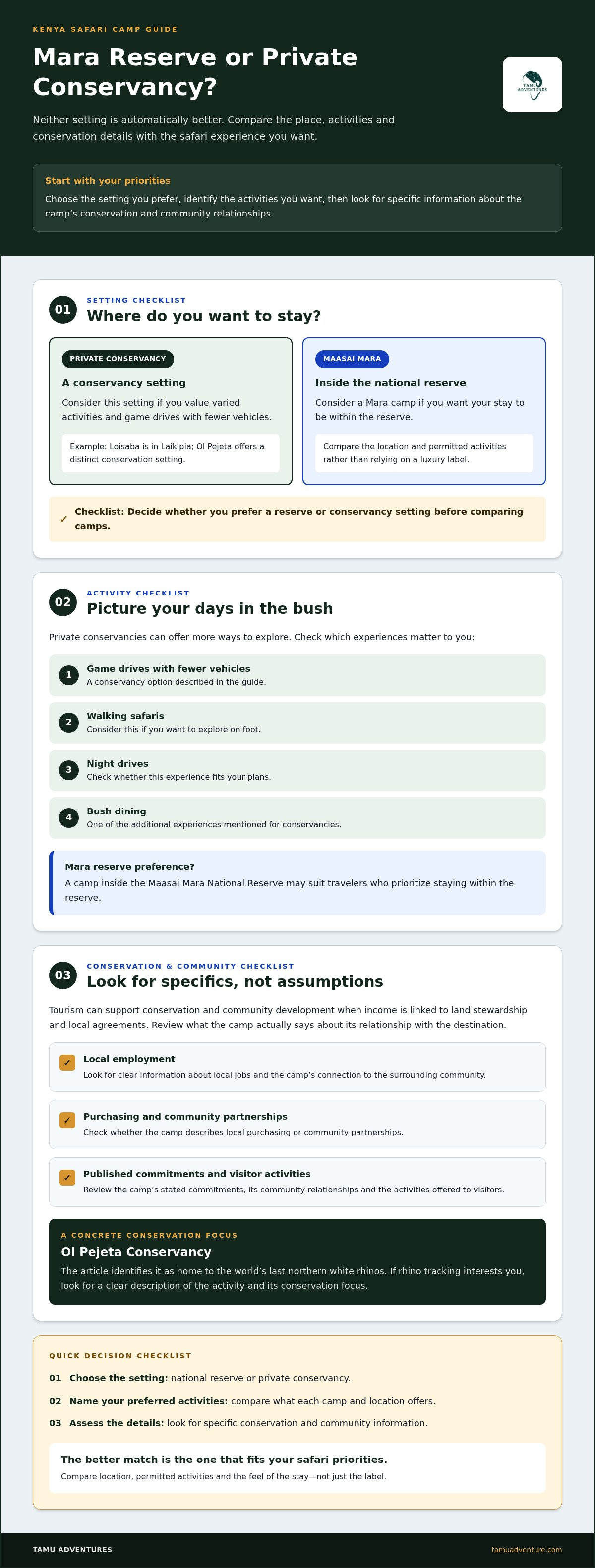
Neither setting is automatically better. The right choice depends on the experience you want. Private conservancies in Kenya offer game drives with fewer vehicles, walking safaris, night drives and bush dining. Camps inside the Masai Mara National Reserve place you within the reserve. Compare location, permitted activities and the feel of each stay instead of relying on a luxury label. These differences help you shortlist handpicked safari camps that suit your plans.
To compare locations and experiences, first decide whether you prefer a national reserve or a private conservancy. Then consider which activities you want during your stay. Conservancy camps can offer varied ways to explore, including walking safaris and night drives, while reserve camps suit travelers who want to stay inside the Mara. Use these preferences to assess handpicked safari camps by the day-to-day experience each setting can provide.
Ol Pejeta Conservancy offers a different conservation setting from the Mara. It is home to the world’s last northern white rhinos, making rhino protection central to understanding the area. If rhino tracking interests you, look for a clear description of the activity and its conservation focus. This helps distinguish a wildlife encounter from the wider work of monitoring and protecting threatened animals.
Conservancy tourism can support conservation and community development when tourism income is linked to land stewardship and local agreements. To assess a camp, look for specific information about its relationship with the conservancy and surrounding communities. Details about local employment, purchasing or community partnerships can help you understand how a stay connects with its destination. Compare those descriptions across handpicked safari camps instead of assuming every property operates in the same way.
To assess a camp’s conservation and sustainability practices, review its published commitments, community relationships and descriptions of visitor activities. Look for specifics, then consider them alongside the camp’s location and the conservancy’s purpose. Ol Pejeta’s northern white rhino conservation work, for example, offers a concrete focus to consider when reviewing a stay’s conservation information.
Use a simple process: choose a reserve or conservancy setting, identify suitable activities, then assess the camp’s conservation and community information. A private conservancy may suit guests who value walking safaris, night drives or bush dining. A camp inside the Mara may suit travelers who prioritize staying within the national reserve. The better match is the one that fits your safari priorities.
3. Booking, group sizes and camp configurations
Start with the camp’s location, then compare its layout with your group’s needs. Eagle View Camp in Naboisho has nine tents, a clear example of a small camp configuration. The tent count does not tell you how many guests share each game drive, so look for separate details about vehicle arrangements and group activities. Couples may value a quieter setting, while families may prioritize practical room layouts and space to regroup between outings.
Booking terms shape your experience before arrival. For a Kenya safari, review what the itinerary includes, how deposits and cancellations work, and which park or conservancy fees apply. Transfers depend on the route between your arrival point, camp and safari areas, so compare the planned journey alongside the accommodation. Get booking details in writing, including the services covered and the terms for changes. This makes it easier to compare camps fairly, without treating the nightly stay as the only consideration.
Camp style and location also shape the rhythm of each day. A tented camp in Naboisho offers a different setting from a lodge near the plains of the Maasai Mara. Consider whether you prefer a fixed base or a more intimate camp atmosphere, then match that choice to your planned game drives and time at camp. A memorable stay is about more than an impressive tent. It also depends on how well the location, pace and facilities suit your group.
Look closely at the facilities that support both activity and rest. A camp’s description may cover shared spaces, dining arrangements or wellness options, but these vary by property. List the features that matter most, such as somewhere to relax between drives or a layout that works for children. Then compare your list with each camp’s stated facilities instead of assuming every luxury safari camp offers the same setup.
For health, safety and packing, use your itinerary and camp setting as practical guides. Bring comfortable walking shoes, sun protection and clothing for changing temperatures. Keep essential personal items accessible during transfers. Follow camp guidance around wildlife and movement, especially after dark. These preparations can help you settle into the safari routine while respecting the camp’s environment.
Before booking, compare three details side by side: the camp’s location, tent configuration and written terms. A group travelling together can weigh shared activities against privacy, while solo travelers can focus on the camp’s social setup. For example, Eagle View’s nine tents give you a clear configuration detail to start with, but the right choice still depends on the journey and daily experience you want.
4. Wildlife experiences and safari guiding
The best Kenyan camp for wildlife viewing depends on the species, landscapes and activities you hope to experience. Angama Mara has more than 570 recorded bird species, making it a strong example for travelers interested in birdlife. Enaidura Camp offers a different point of comparison in the Maasai Mara, where guiding and the surrounding habitat shape each drive. Choose by matching your interests with the camp’s location and the activities available there.
For a northern Kenya experience, consider Sasaab and the Samburu region. Samburu wildlife includes Grevy’s zebra, reticulated giraffe and gerenuk, offering a different focus from a Mara itinerary. A camp’s setting can influence which habitats you explore and how each day unfolds. Consider whether you’re most interested in particular species, varied landscapes, birdwatching or a mix of safari activities. Your answer can help narrow the right location.
Views can add context to wildlife viewing, but they do not replace knowledge of the habitat. A camp overlooking open plains may make it easier to scan the landscape, while a guided drive lets you explore different areas. Consider the full safari experience: time on drives, birdwatching opportunities, walking activities where offered, and the pace between outings. Angama Mara’s recorded bird diversity gives you a specific reason to consider birdlife as part of your decision.
Guides add context to what you see. They can help interpret animal behaviour, tracks and habitat, turning a sighting into a fuller understanding of the landscape. At Enaidura, co-owner Johnson Ping’ua “Ping” Nkukuu is training Sialo “Sarah” Shonko as a guide to increase women’s involvement in the safari industry. This example shows how guiding can connect wildlife experiences with people and skills in the safari sector.
Before choosing, compare the region’s wildlife, the activities available and the guiding experience described by the camp. For example, a traveler drawn to Samburu species could consider a Sasaab stay, while a bird-focused traveler may look at Angama Mara’s recorded birdlife. For a Maasai Mara trip, compare the camp’s setting and guiding approach with the experience you want. No single location covers every interest, so decide which wildlife and activities matter most to your plans.
Use your shortlist to weigh the setting against how you want to spend your time exploring. For a drive-focused itinerary, consider the guiding and access to different habitats. If you’re interested in birds, recorded species and a guide’s ability to interpret birdlife are useful factors. The best fit is the camp whose location and activities align with your priorities, creating a personal safari experience without treating any sighting as the measure of a successful trip.
5. Tented accommodation and en-suite facilities
A tented suite can offer a close connection to the landscape and a private place to rest. Mara Expedition Camp, for example, has five tented suites. That figure describes the camp’s accommodation scale, not the facilities in each suite. Before booking, review the room description for an en-suite bathroom, bathing setup, storage and sleeping arrangements. These practical details show whether a camp’s style matches your preferred level of comfort.
Couples may prefer a private suite and calm layout, while families often need sleeping arrangements that keep everyone comfortable. Check how the camp describes adjoining or family accommodation and whether the layout suits your group. Parents travelling with children, for instance, can prioritize clear room configurations and convenient access to shared areas. Couples planning a quieter stay can focus on privacy and the balance between time at camp and time on drives.
Facilities can make the difference between a tent that looks appealing and one that works for your trip. Compare the listed bathroom features, ventilation, lighting and storage. Then consider how the camp supports relaxation between drives, such as with shared sitting areas or wellness facilities where offered. Don’t assume every tented camp has the same setup. Comparing each property’s description helps you see what is included.
Budget comparisons are clearer when you review the full stay rather than a headline figure. Safari accommodation pricing depends on the case and is provided after a quote request. Season, location, room configuration and included services affect the total. Compare quoted prices with the length of stay, meals, activities and transfers described in the itinerary. This gives families and couples a more useful basis for comparing options without treating different inclusions as like-for-like.
For a family-friendly choice, start with the room layout, then consider the camp’s setting and daily schedule. A family trip with early game drives may call for a practical routine and restful space between outings. Couples may place more weight on privacy and an exclusive feel. In either case, look for clear information about facilities and accommodation arrangements before deciding. A well-described stay makes it easier to match comfort with the safari experience you want.
Sustainable design can also matter to travelers choosing a tented stay. Consider how the camp describes its relationship with the surrounding landscape, alongside the comfort features that matter to you. The word “sustainable” alone doesn’t explain how a property operates, so look for specific details in its accommodation information. For a Kenya family trip, explore family safari options that bring accommodation style and travel plans together.
Tamu Adventures: Wildlife Safaris
Tamu Adventures plans personalized East African safari journeys, matching camp style, location and itinerary to your travel priorities. Its Wildlife Safaris can suit travelers comparing Mara and conservancy stays, while Luxury Safaris, Family Safaris and Honeymoon Trips offer options for different kinds of journeys. Share what you want from the experience, such as time for game drives, a comfortable tented stay or a family-friendly pace, to guide the planning conversation. Coordinating accommodation and activities can bring them together in one itinerary. For help planning a Kenya safari, contact Tamu Adventures or visit tamuadventure.com.
Shape Your Mara Stay Around the Experience You Want
Turn your camp preferences into a trip that feels balanced from arrival to departure. Decide what matters most, such as time in the reserve, activities beyond game drives, tented accommodation or a pace that suits everyone travelling. Use those priorities to compare handpicked safari camps by setting and style, rather than appearance alone. A shortlist of handpicked safari camps can help you see which options best fit your preferred itinerary.
Tamu Adventures can bring those choices together in a Kenya itinerary through its Wildlife Safaris, Luxury Safaris and Family Safaris. Whether you’re planning your first wildlife trip, a comfort-focused stay or a journey with children, consider the camp and route together. Share what you want from the trip, then use those preferences to shape a practical shortlist of handpicked safari camps.
Contact Tamu Adventures to plan your safari, and start shaping a Mara stay that feels right for your journey.
Frequently Asked Questions
Are private conservancy camps better than camps inside the Masai Mara?
Neither option is universally better. The difference lies in the setting and range of activities. Conservancy stays offer options such as walking safaris and night drives, while camps inside the reserve place you within the Maasai Mara National Reserve. For a trip with varied activities, compare conservancies. For a reserve-focused stay, compare camp locations within the Mara. Your preferred daily routine can help you decide.
What is the best safari camp in Kenya?
There is no single best camp for every Kenya safari, because location, activities and accommodation style shape the experience. Start by choosing the wildlife region you want to visit, then decide whether a tented camp or lodge better suits your plans. A birding-focused itinerary, for example, calls for different priorities from a trip centered on family comfort. The best choice is the one that fits your route and travel style.
What does “handpicked safari camps” mean in Kenya?
In Kenya, “handpicked safari camps” means a curated selection chosen to match a traveler’s destination, comfort preferences and trip priorities. It describes how options are selected, not a formal certification or a guarantee of a particular experience. Compare each camp’s location, accommodation and activities individually. A camp selected for a migration-focused itinerary, for example, may not suit someone prioritizing birdwatching or a quieter pace.
What are the best handpicked safari camps in Kenya?
The best options depend on what you want from your itinerary. Loisaba Tented Camp offers a Laikipia conservancy setting, while Mara Expedition Camp provides tented suites in the Mara. Lewa Wilderness Lodge is another option for a lodge stay in Kenya. Compare regions and accommodation styles, then shortlist camps that match your route and preferred activities rather than treating any one property as the best fit for everyone.
What are typical nightly prices for safari camps in Kenya?
There is no single nightly rate for Kenya’s safari camps. Pricing depends on the case and is provided after a quote request. Season, location, accommodation type, meal arrangements and included activities affect the cost. Transfers and length of stay also shape the overall itinerary. Compare inclusions alongside the nightly price, so you’re weighing similar accommodation and travel arrangements rather than headline figures alone.
Which safari camps in Kenya are best for families, couples, or honeymooners?
For families, prioritize sleeping arrangements, the daily pace and how easily the itinerary accommodates different interests. Couples and honeymooners often give more weight to privacy, setting and time to relax between activities. Mara Expedition Camp, for example, has tented suites, while a lodge or conservancy camp offers a different setting. Compare each camp’s room details with your group’s needs before planning the rest of the safari.
What amenities and activities do Kenya safari camps offer?
Activities vary by location and camp. In private conservancies, options can include game drives, walking safaris, night drives and bush dining. Accommodation details vary too, so review each camp’s description for the facilities and services that matter to your stay. Make a short list of preferred activities and comfort needs, then compare which camps describe a suitable combination for your itinerary.
How far in advance should I book safari camps in Kenya?
Book when your travel dates and preferred regions are taking shape, especially if you have a specific camp style or room arrangement in mind. Demand can rise around popular wildlife seasons, and smaller camps have fewer accommodation units to allocate. Confirm your intended route before choosing stays, since location affects transfers and itinerary order. Planning early also gives you more time to compare camp configurations with your group’s needs.


