

What if the best Kenya safari moments come not from ticking off the Big Five, but from settling into the pace of the wild? If you’re wondering what to expect on a Kenya safari, it’s natural to picture long drives and constant animal sightings. The experience is more varied: wildlife encounters are never guaranteed, and patience is part of the journey.
A typical day often starts with an early game drive, followed by time to rest at camp during the warmer hours and another drive later in the day. Some outings bring memorable sightings; others are quieter, with changing landscapes and smaller details to notice. That rhythm gives you room to enjoy the journey without treating each drive as a checklist.
This guide explains how safari days unfold, what camps and meals can be like, and how to prepare for comfort. You’ll also see how your choice of camp, itinerary, and travel pace shapes the experience. Planning around your interests and comfort can help make a first safari feel more manageable, rewarding, and relaxed.
Key Takeaways
- Learn what to expect on a Kenya safari, from guided wildlife viewing to the way your route and timing shape each day.
- Use an illustrative safari-day sequence to picture the flow, while allowing for schedules to vary between trips.
- Set realistic expectations for wildlife encounters and discover why the Big Five is not a guaranteed checklist.
- See how practical packing, respectful safari etiquette, and choosing accommodation to suit your comfort can help you feel prepared.
- Explore how your interests and preferred pace can guide a personal itinerary, including the camps and lodges you stay in.
What to expect on a Kenya safari: the overall experience
A first safari can bring excitement about seeing wildlife and uncertainty about how the days will unfold. A useful way to understand what to expect on a Kenya safari is to think of it as guided wildlife viewing shaped by where you travel, when you go, and how your itinerary is arranged. It isn’t a fixed sequence of sightings. The landscape and its wildlife set the pace, while your guide helps you interpret what you encounter.
Kenya’s safari destinations offer different settings and experiences. The Maasai Mara National Reserve, for example, is widely associated with open grasslands and the annual wildebeest migration. Other destinations have their own scenery and wildlife. Choosing a destination is about more than selecting a famous name: it shapes the surroundings, travel between locations, and activities that make up your trip.
What makes a safari different from a regular holiday?
A safari day often revolves around wildlife viewing, journeys between locations, and time at camp. Instead of moving through a list of attractions at a fixed pace, you spend time in natural habitats where conditions can change. Your guide can interpret animal behaviour, tracks, and details in the landscape, adding context to what might otherwise look like an ordinary stretch of grass or bush.
Not every rewarding moment is a dramatic encounter. Watching a herd move across the plains, noticing birds near a water source, or learning how tracks tell a story can make a quiet drive memorable. Staying patient and curious helps you enjoy the experience without measuring every outing by its headline sightings.
How much can the experience vary?
Your travel style makes a practical difference. A private trip can offer more flexibility around your group’s interests and pace, while shared travel lets you explore alongside other guests. Neither is automatically right for everyone. Consider whether you value more control over the day or enjoy sharing the vehicle and decisions with fellow travellers.
Accommodation also shapes the feel of a safari. Camps, lodges, and hotels vary in comfort, facilities, and atmosphere, so your stay may feel like a quiet retreat or a sociable part of the journey. Activity choices and the time allowed at each destination matter too. A tightly scheduled itinerary prioritizes covering ground; a slower one leaves more room to settle in. Tamu Adventures plans personalized journeys around travellers’ interests, schedules, comfort, and preferred pace, with handpicked accommodation options.
For broader trip-planning considerations, use a Kenya wildlife safari planning guide to think through destination choices and itinerary design. Decide what matters most before comparing specific arrangements. With clear priorities, it’s easier to choose a safari style that feels comfortable and realistic, while leaving room for the unexpected moments that make each journey its own.
A typical day on a Kenya safari, from first drive to evening
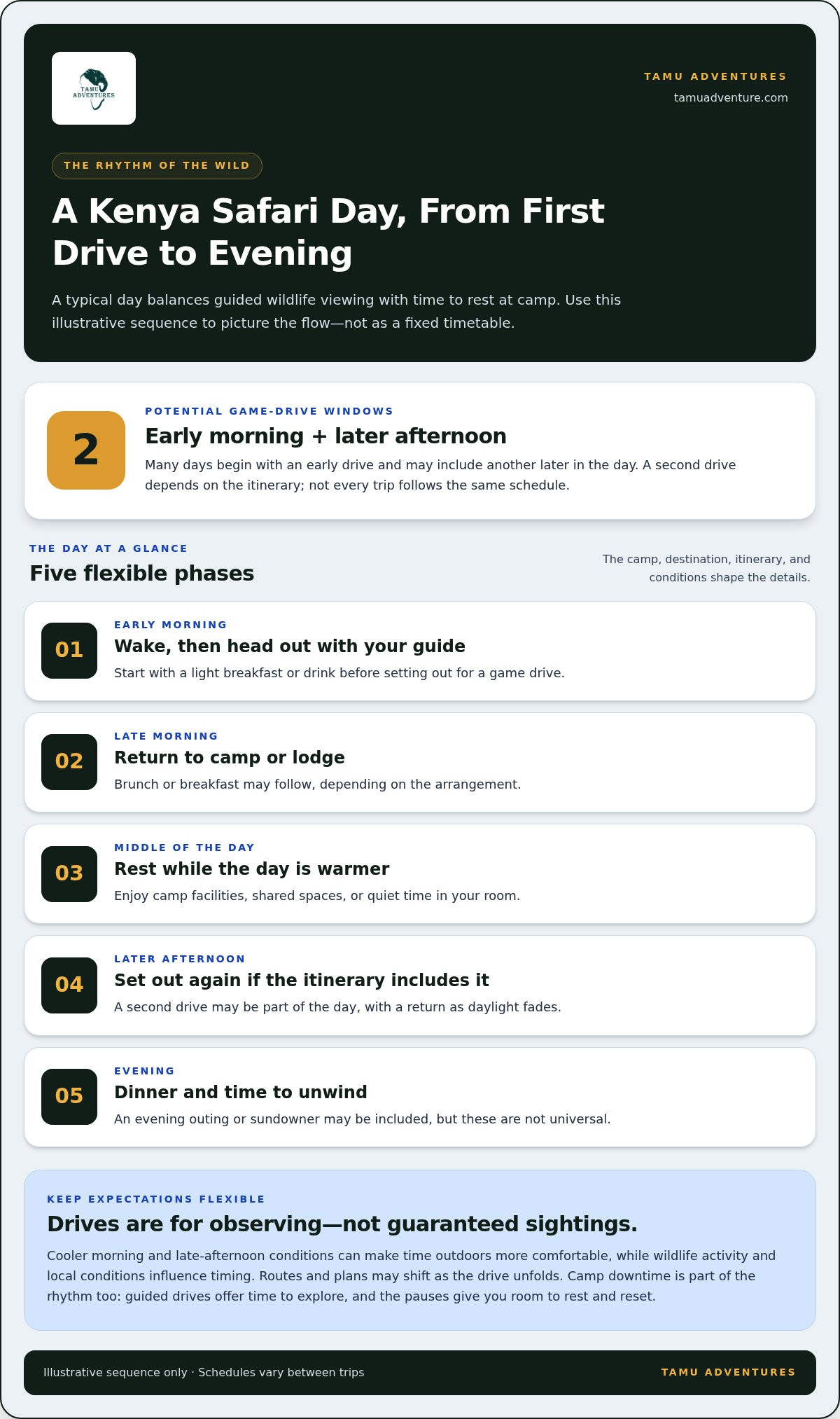
Safari days often begin early, when the air is cooler and the light is gentle. That doesn’t mean every morning follows the same timetable or brings a particular sighting. The schedule depends on the camp, destination, itinerary, and conditions that day. This outline is illustrative, not a fixed programme.
- Early morning: Wake, have a light breakfast or drink, then set out with your guide for a game drive.
- Late morning: Return to camp or a lodge for brunch or breakfast, depending on the arrangement.
- Middle of the day: Rest, enjoy the camp facilities, or spend quiet time in your room while the day is warmer.
- Later afternoon: Set out again if a second drive is part of the itinerary, then return as daylight fades.
- Evening: Enjoy dinner and time to unwind. Some itineraries may include an evening outing or a sundowner, but these aren’t universal.
This gives you a practical sense of what to expect on a Kenya safari without suggesting every trip runs to a clock. Some itineraries include one main drive; others offer more opportunities to explore. Your guide and the day’s conditions help shape the details.
Why game drives often happen in the morning and later day
Cooler morning and late-afternoon conditions can make time outdoors more comfortable. Wildlife activity and local conditions also influence drive timing. Your guide chooses routes based on the area, current conditions, and what may be worth exploring. Plans can shift as the drive unfolds, so there is no single route or schedule for every safari.
Think of a drive as time spent observing, not a timed trip between guaranteed sightings. Pausing to watch the landscape or follow a trail can be part of the experience. Follow your guide’s instructions and allow the outing the time planned for your itinerary.
What happens between drives?
Time at camp is part of the rhythm, not a gap you need to fill. Meals give you a chance to refuel, and resting between outings can make early starts feel more manageable. Depending on the accommodation, downtime might mean relaxing in your room, enjoying shared spaces, or taking in the surroundings.
Think of the day as a balance: guided drives offer time to explore, while camp downtime gives you room to rest and reset. Sundowners or other optional activities may add variety when an itinerary allows, but they aren’t a standard feature of every safari. When planning, consider the pace that feels comfortable for you. Tamu Adventures shapes personalized itineraries around travellers’ schedules, interests, and comfort. Before departure, the CDC travel health guidance for Kenya offers advice on travel health and insect-bite prevention for time outdoors.
Wildlife sightings on a Kenya safari: what is realistic?
Wild animals live and move freely in their natural habitats, not on a schedule. What you see can depend on the location, weather, time of day, and chance. A guide’s local knowledge can help make the most of the conditions, but it can’t control them. No responsible itinerary can promise specific animal sightings.
Keep that expectation in mind on every drive. One outing may bring a close view of a large animal; another may be quieter, with tracks, birds, or changing scenery to notice. Patience matters. So does time outdoors: slowing down and observing can help you learn from an encounter, even if it isn’t with the species you hoped to see.
The Big Five, the Great Migration, and other wildlife expectations
The Big Five are the lion, leopard, elephant, rhinoceros, and Cape buffalo. The name is a familiar grouping, not a scorecard for judging a safari. Seeing all five is never assured, and a trip can be rewarding without a complete set.
The Great Migration is the seasonal movement of wildebeest and other grazing animals between Tanzania’s Serengeti and Kenya’s Maasai Mara. Its timing and location shift with natural conditions, so a particular event, such as a river crossing, can’t be scheduled to match a visitor’s plans. If seasonality is central to your trip, consult a best-time-for-a-Kenya-safari guide as part of your planning. Timing a visit around wildlife movement can offer a different setting, but it doesn’t remove the uncertainty of viewing animals in the wild.
How to enjoy encounters without chasing a checklist
Pay attention to behaviour as well as species. Notice how animals move, feed, rest, or respond to their surroundings. The landscape is part of the experience too, and your guide can help explain what you’re seeing. Routes may change as conditions develop or new information about sightings becomes available, so an adaptable plan is more useful than expecting every drive to follow a fixed script.
At a sighting, quiet observation helps keep the moment calm. Stay seated as directed, keep a respectful distance, and follow your guide’s instructions. Don’t call, approach, or try to draw an animal closer for a photograph. These choices support considerate viewing and help you focus on what is happening naturally.
In practical terms, what to expect on a Kenya safari is a mix of possibility and uncertainty. You might see familiar species, discover animals you hadn’t anticipated, or spend time reading the landscape between sightings. Flexible expectations let you appreciate each encounter for what it is, rather than comparing the day with a checklist or someone else’s story.
What to prepare for comfort, camp life, and safari etiquette
Thoughtful preparation makes safari days more comfortable, but you don’t need specialist gear. Pack for time outdoors, changing conditions, and the practical details of your itinerary. To prepare for what to expect on a Kenya safari, consider both game drives and the quieter hours at camp.
What to pack for a comfortable safari
Choose comfortable, practical clothing that lets you move easily and suits outdoor activities. Layers can help you adjust as conditions change during the day. Pack sun protection and personal essentials, including any medication you rely on. A camera or binoculars can be useful, but they’re optional; watching with your own eyes is part of the experience too.
Keep your day bag simple, with essentials easy to reach. A reusable water bottle can be handy, and single-use plastics are restricted in Kenya’s national parks, reserves, and conservancies. For weather-specific choices, use a separate seasonal guide to decide what to bring for your travel dates.
Accommodation affects what you’ll want close at hand and the atmosphere of your stay. A camp, lodge, and hotel may differ in facilities, layout, and how close you feel to the surrounding landscape. Standards aren’t identical across properties. Tamu Adventures selects handpicked camps, lodges, and hotels to match travellers’ comfort preferences and trip plans, so consider which facilities matter most to you.
How to be a considerate safari guest
Follow your guide’s instructions during wildlife viewing and remain in designated areas. Keep your voice low, avoid sudden movements, and don’t try to attract an animal’s attention. These choices show respect for wildlife and help fellow guests enjoy the moment. Ask your guide before taking an action you’re unsure about, especially near animals or in camp.
Camp etiquette matters too. Be considerate of other guests during shared meals and quiet hours, and follow the camp team’s guidance about moving around the property. At some unfenced camps, wildlife may move nearby after dark, so use the arrangements provided for getting around safely.
Interactions with local communities are an opportunity to learn, not a performance arranged for visitors. Approach people with respect, listen, and follow local guidance. Ask before taking photographs, and be open to learning about daily life without treating anyone as an attraction.
Comfort comes from practical preparation and a flexible attitude, not from owning specialist equipment. Tamu Adventures can shape a safari itinerary around your preferred comfort, interests, and pace, with accommodation choices considered as part of the journey. Explore personalized safari options to find an approach that feels right for you.
Make your Kenya safari feel well-paced and personal
A trip feels more comfortable when its moving parts work together. Your travel style, interests, accommodation, and preferred pace all influence how each day feels, from time spent travelling between destinations to how you unwind at camp. A well-planned itinerary makes room for these choices instead of making every day feel like a rush to fit everything in.
Match the itinerary to your travel style
Start by thinking about what you most want from the journey. You might prefer to devote more time to wildlife viewing, choose comfortable stays, or build in extra time to rest between outings. Your schedule and budget also help shape the options. There isn’t one ideal balance for every traveller, so a useful plan reflects your priorities rather than copying someone else’s itinerary.
Tamu Adventures plans personalized journeys around travellers’ interests, schedules, budgets, comfort, and preferred pace. Handpicked camps, lodges, luxury camps, and hotels can be matched to the kind of stay you want, while the itinerary is shaped around how you prefer to spend your time. Connecting daily plans with accommodation helps make the overall journey feel considered.
If you’re weighing up what matters most, explore personalized safari planning to see how your priorities can guide the shape of a trip.
For example, a traveller focused on wildlife viewing may want an itinerary that allows time to settle into a destination, while someone who values a slower holiday may prefer a gentler sequence with space to rest. A family or group may have different comfort needs from a couple travelling together. These are starting points, not fixed formulas. Sharing your preferences helps the itinerary reflect the experience you’re hoping to have.
What guided planning can take off your plate
Planning involves more than choosing destinations. The route, pace, accommodation, and daily activities need to fit together for your available time and comfort. Tamu Adventures offers curated safari packages as well as personalized itinerary planning, bringing those decisions into one considered trip. Its 15+ curated safari packages provide starting points for different travel interests, while personalized planning can shape the details around your needs.
Support continues through the journey, with 24/7 support as part of Tamu Adventures’ offering. A coordinated plan can make it easier to focus on enjoying each place instead of managing every detail yourself. It won’t make wildlife sightings predictable, but it can help the travel flow feel clear and comfortable.
Now that you know what to expect on a Kenya safari, take the next step at a pace that suits you. Explore Kenya safari packages or discuss a personalized journey with Tamu Adventures.
Start shaping a safari that feels right for you
Before choosing an itinerary, picture the kind of holiday you want to come home from. Would you like full days focused on exploring, or more breathing room between activities? Are there particular places or experiences that matter most to you? A few clear priorities can make planning more straightforward while leaving room for the unexpected moments that make a journey memorable.
Knowing what to expect on a Kenya safari isn’t about predicting every detail. It’s about starting with a realistic sense of the experience, then shaping a trip around what will help you feel comfortable and present along the way. Your preferences can guide the route, travel rhythm, and places you stay.
When you’re ready to turn those ideas into a plan, explore Kenya safari packages and find a journey that fits your pace. Take the next step with confidence, knowing your safari can be shaped around the experience you want.
Frequently Asked Questions
Is a Kenya safari suitable for a first-time safari traveller?
Yes, you don’t need previous safari experience to enjoy one. A guided itinerary gives your days structure, while the pace and comfort level can be planned around your preferences. Expect some early starts and time outdoors, and remember that wildlife sightings are never certain. If you’re new to game drives, let your guide know what you’re curious about. Asking questions can help you feel at ease and understand what you’re seeing.
Can safari plans change during a Kenya trip?
Yes, daily plans may adapt to road, weather, wildlife, or operational conditions. Your guide might adjust the timing or route in response to what’s happening on the ground. That flexibility is a normal part of travelling through natural environments, not necessarily a sign that planning has gone wrong. Keep essentials you may need during an outing close at hand, and follow your guide’s updates if arrangements shift.
Will I have mobile phone signal throughout a Kenya safari?
No, you shouldn’t assume you’ll have continuous mobile coverage throughout your safari. Signal can vary with location, accommodation, and network. Before departure, check your roaming arrangements and save important details, such as booking information and key contact numbers, for offline access. You may also want to let family or friends know that replies could be delayed. Time away from connectivity can be a welcome chance to focus on the surroundings.
Do I need binoculars for a Kenya safari?
No, binoculars aren’t essential for every traveller, though they can help you observe wildlife from a respectful distance. You can also enjoy a drive by watching from the vehicle and listening to your guide’s explanations. If you bring binoculars, choose a pair you can hold comfortably and keep within easy reach. Use them when helpful without feeling you need to watch every moment through a lens.
Can I take photographs during a Kenya safari?
Yes, you can take photographs, provided you follow your guide’s instructions and avoid disturbing animals or people. Be patient and keep noise low rather than trying to prompt a reaction for a picture. Ask permission before photographing individuals. During drives, secure your camera and other equipment so they don’t shift around. A photograph is a keepsake, but it shouldn’t take priority over a safe, respectful encounter or listening to your guide.
Are safari drives always in open-sided vehicles?
No, vehicle styles can differ by itinerary and operator, so don’t assume every drive will use an open-sided vehicle. The vehicle is selected to suit the journey and conditions. Think about practical comfort and visibility, and listen to your guide’s instructions once you’re on board. Keep your belongings secure and avoid leaning or reaching outside the vehicle while it’s moving. Focus on the experience rather than a particular vehicle style.


